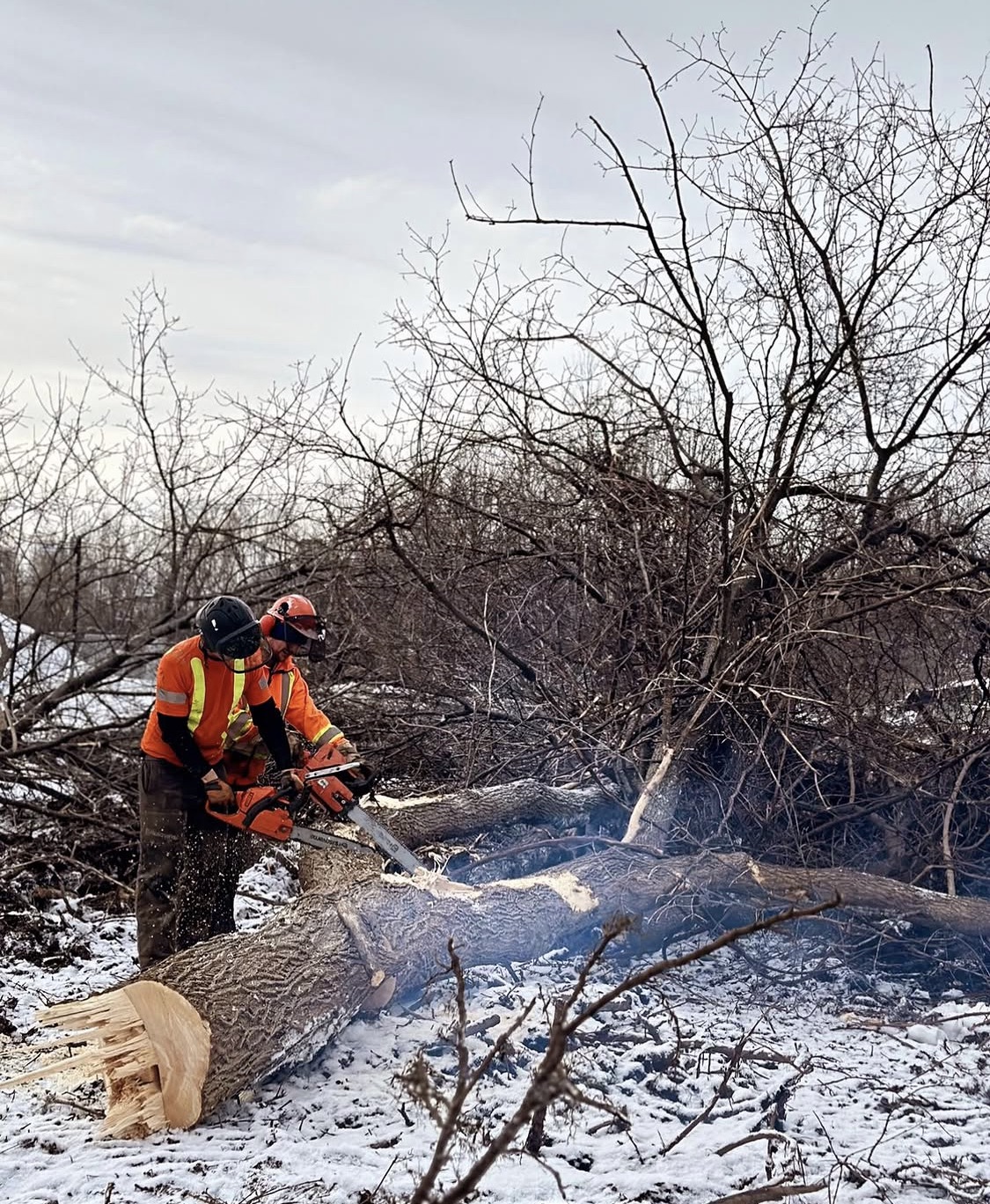
A Practical Permit Guide for Homeowners on Both Sides of the River
If you are planning to remove a tree in Ottawa, Gatineau, Cantley, or Chelsea, the first question should not be about chainsaws or pricing. It should be whether the municipality expects a permit or certificate before any cutting starts. Tree removal bylaws matter because they are designed to protect public safety, preserve tree canopy, reduce avoidable damage to neighbouring properties, and limit unnecessary cutting in sensitive urban and environmental areas. In practical terms, a permit problem can delay a project, create fines, or turn what seemed like a simple backyard job into a much larger issue. Ottawa and Gatineau both regulate private-tree removal, but they do it in different ways. The same is true in Cantley and Chelsea, where setback rules, buffer zones, and local zoning standards can change what is allowed on a given lot.[1] [2] [3] [4] [5] [6]
This article is written for homeowners, not lawyers. It explains the most important permit patterns by city, points out common exemptions for dead, dangerous, or diseased trees, and highlights the neighbourhood-specific realities that often matter in places such as Vanier, Nepean, Greely, Stittsville, Kanata, Cumberland, Aylmer, Hull, Buckingham, Cantley, and Chelsea. Bylaws can change, municipal maps can be updated, and site conditions always matter, so you should verify the current requirement with the municipality before work begins.[1] [2] [3] [4] [5] [6]
Permit rules at a glance
The table below gives a homeowner-friendly summary. It is useful for planning, but it should not replace direct confirmation from the municipality for your exact address.
| Area | Neighbourhood or sector context | Common threshold | What homeowners should expect |
|---|---|---|---|
| Ottawa | Vanier, Nepean, Greely, Stittsville, Kanata, Cumberland, and other urban or village properties | Urban rules commonly turn on 30 cm distinctive trees on lots 1 hectare or less, with additional 10 cm rules for larger sites or Planning Act files. | A city permit is required for protected trees, but Ottawa exempts dead or hazardous private trees that are an immediate threat and also exempts ash trees infested with emerald ash borer. |
| Gatineau | Gatineau sector, Aylmer, Hull, Buckingham, and other urban residential areas | The city states that deciduous and coniferous trees measuring 10 cm or more in diameter at 1.3 m from the ground are subject to tree-cutting constraints. | Tree removal on private property requires a certificate of authorization before work starts, subject to the city approving one of its listed reasons for removal. |
| Cantley | Residential lots, wooded parcels, riparian areas, and buffer zones | Living trees over 10 cm in diameter at 1.3 m generally trigger municipal authorization rules, while some small-volume removals outside protected screens may be handled by work declaration. | Cantley regulates both tree cutting and riparian-area clearing, and broader removals or work in protected areas move beyond a simple homeowner decision. |
| Chelsea | Village lots, rural residential properties, riverfront areas, and wetland-adjacent sites | Chelsea states that cutting trees with a trunk diameter greater than 10 cm measured at 30 cm from ground level is prohibited except in certain circumstances. | Chelsea also highlights setback-based restrictions, especially near property lines, riparian strips, and wetlands, while exempting sick, harmful, dangerous, or dead trees from permit requirements. |
Why permits matter before a tree comes down
Homeowners usually start thinking about permits when a tree is already causing stress. Maybe roots are crowding a foundation, a mature maple is leaning over the driveway, or storm damage has exposed a split stem above the roofline. Municipal rules matter because the condition of the tree is only one part of the decision. The city may also care about diameter, lot size, proximity to wetlands or riparian strips, planning status, or the effect on neighbouring lots and urban canopy. That is why a tree that looks like an obvious removal candidate to a homeowner may still need formal review before work starts.[1] [2] [5] [6]
Permits also create a record. When a tree is clearly dead, dangerous, or diseased, the municipality may allow removal without the usual permit path or may approve it more readily. Even then, it is smart to document the condition with photos and contact the municipality before moving forward, especially if the tree is near a neighbour's fence, a right-of-way, a wetland buffer, or a power-related access corridor.[1] [2] [4] [5]
Ottawa: urban trees, village properties, and why location matters
In Ottawa, the key rule for many homeowners is the Tree Protection By-law. The city says protected trees on private property include distinctive trees that are 30 cm or more in diameter at breast height on urban lots that are 1 hectare or less. The city also protects 10 cm and larger trees on certain urban properties over 1 hectare and on urban properties involved in specific Planning Act applications. That means the answer can change depending on whether you are on a compact urban lot, a larger parcel, or a property already tied to a development or planning file.[1]
For homeowners in Vanier and Nepean, the urban setting often means tighter lots, closer neighbouring homes, and more obvious bylaw sensitivity around canopy loss and adjacent structures. In Stittsville, Kanata, and Cumberland, the lot pattern may feel more open in some areas, but the bylaw still matters where urban rules or expansion-area mapping apply. In Greely, homeowners should be especially careful not to assume a semi-rural feel means there is no city oversight. Ottawa specifically notes that privately owned tree protections also apply in identified urban expansion or growth areas shown in the by-law schedules.[1]
Ottawa also lists important exemptions. A permit is not required to remove dead or hazardous private trees that are an immediate threat to public health and safety, and the city separately exempts ash trees infested with emerald ash borer. Even with those exemptions, the city advises property owners to photograph the tree before removal as evidence of its condition. If you are trying to understand whether your situation points toward a standard permit, an exemption, or a hazard-based response, our Ottawa tree removal service page gives additional local context on common residential scenarios.[1]
Gatineau: authorization first, then city-approved reasons for removal
Gatineau takes a direct approach. The city states that anyone who wants to remove a tree on private property must obtain a certificate of authorization before starting the work. The municipality also states that deciduous and coniferous trees measuring 10 cm or more in diameter at 1.3 m above the ground are subject to tree-cutting constraints in the urban environment. For homeowners, that means Gatineau often starts from the assumption that the city wants to review the removal before the saw starts, rather than after the fact.[2] [3]
The city also explains the kinds of reasons that may justify removal, subject to approval. Those reasons include a dead tree, an incurable disease, insect infestation threatening survival, dangerous condition, property damage, unreasonable nuisance, pressure on healthier neighbouring trees, and certain conflicts with existing or future construction, parking, pools, accessory structures, fences, or septic systems.[3] That is highly relevant in built-up neighbourhoods such as Hull and Aylmer, where access is tighter and neighbouring properties are close, and also in larger residential settings around Buckingham or the Gatineau sector, where trees may interact with septic layouts, additions, or long driveways differently.
A useful practical point for Gatineau homeowners is that the city channels residents through 311 or its online request process for the authorization workflow.[2] If you are comparing permit planning with site logistics, our Gatineau tree removal page explains how local residential removals are typically approached in Aylmer, Hull, Buckingham, and nearby sectors.[2] [3]
Cantley: authorization rules plus riparian and buffer considerations
Cantley is a good example of why homeowners should not treat rural-feeling properties as permit-free. The municipality's tree-cutting brochure says an authorization certificate is required for the removal of one or more living trees over 10 cm in diameter measured 1.3 m above the adjacent ground level, unless the cutting is already tied to a development or construction project authorized by the municipality. That is a meaningful trigger for wooded residential lots where homeowners may want to clear selectively without realizing the municipality distinguishes between ordinary yard work and regulated tree cutting.[5]
Cantley also adds an environmental layer that matters on large lots and edge-of-forest properties. The municipality states that tree cutting and clearing are prohibited within a 15 metre riparian protection strip measured from the natural high-water mark of a watercourse or connected wetland, and within 5 metres of a closed wetland unless provincial authorization documentation is provided.[5] That makes shoreline, drainage, and wet-area context especially important before a homeowner assumes a tree can come down simply because it is on private land.
Cantley's current permits-and-certificates regulation adds a useful operational detail for homeowners: removing three living trees or fewer outside a vegetative screen or buffer zone can be handled by declaration of work, limited to one declaration per calendar year, while other living-tree removal requests outside those areas require an authorization certificate. The same regulation also says pruning a living tree to remove dead, diseased, badly placed, harmful, or dangerous branches does not require a declaration of work when done in compliance with zoning rules.[6]
Chelsea: tree cutting is tied closely to setbacks and environmental protection
Chelsea's official tree page and municipal-laws page show that the municipality treats tree cutting as both a zoning and environmental issue. Chelsea states that tree cutting is prohibited within setback areas identified in its zoning by-law, including property setbacks, a 15 metre riparian protection strip, and a 30 metre wetland protection strip. The municipal-laws page also says it is prohibited to cut trees with a trunk diameter greater than 10 cm measured at 30 cm from ground level, except in certain circumstances.[4] [7]
That matters in Chelsea because many residential properties sit near natural features, sloped land, or wooded edges where the setback issue can become just as important as the tree's size. A homeowner may be less concerned about neighbourhood canopy than in central Ottawa, but more affected by riparian limitations, wetland buffers, or property-line setbacks. Those details can change what is possible even if the tree is fully on private land.[4] [7]
Chelsea also clearly states that cutting sick, harmful, dangerous, or dead trees does not require a permit, while strongly recommending that residents contact the municipality if there is any doubt and take photos before the work if they believe they can proceed without one.[4] For homeowners, that is a reminder that even an apparent exemption should still be documented carefully.
Common permit thresholds and common exemptions homeowners should know
Across these municipalities, the most common thresholds revolve around tree diameter, location on the property, and environmental context. Ottawa's private-property rules often hinge on whether a protected tree is 30 cm or more on an urban lot of 1 hectare or less, although 10 cm thresholds also appear on larger urban sites and planning-related properties. Gatineau uses a 10 cm diameter threshold for trees subject to urban tree-cutting constraints. Cantley and Chelsea also reference 10 cm triggers, but they combine them with buffer, screen, setback, and wet-area considerations that can be just as important as the size measurement itself.[1] [3] [5] [6] [7]
The most common exemptions or approval-friendly conditions involve trees that are dead, dangerous, seriously diseased, insect-infested, or causing specific property conflicts. Even so, homeowners should resist the temptation to treat every declining tree as automatically exempt. Municipal pages regularly recommend documentation, photos, or direct confirmation from staff, and that is the safest habit to follow.[1] [2] [3] [4]
This article is provided for general information only and is not legal advice. Municipal bylaws, maps, permit processes, and exemptions can change, so homeowners should always verify the current requirement with the City of Ottawa, Ville de Gatineau, the Municipality of Cantley, or the Municipality of Chelsea before removing a tree.[1] [2] [3] [4] [5] [6] [7]
Frequently asked questions
Does every tree removal in Ottawa or Gatineau need a permit?
No. Permit rules depend on the municipality, the size of the tree, the exact location on the lot, and the condition of the tree. The safest approach is to assume the rules may apply until the city or municipality confirms otherwise.
What if the tree is dead, dangerous, or diseased?
Those conditions often create an exemption or a stronger basis for approval, but homeowners should still document the tree with photos and verify the municipality's current process before removing it. An emergency threat does not always erase the need for documentation.
Do urban lots get reviewed more strictly than rural properties?
Often, yes. Ottawa's by-law draws important lines between urban properties, village settings, and larger parcels, while Chelsea and Cantley also pay close attention to buffers, setbacks, and environmentally sensitive areas. In compact neighbourhoods, the impact on adjacent properties is a bigger issue.
Can my tree company tell me with certainty whether I need a permit?
A good arborist can help you spot warning signs, explain the usual municipal triggers, and point you toward the right office. Final confirmation should still come from the municipality, because bylaws, mapping, and administrative practices can change.
What should I prepare before calling the city?
Have the property address, recent photos, the tree location on the lot, an estimate of size, and a short explanation of the issue ready. If the tree is close to a house, septic area, wetland, or neighbouring property, mention that immediately.
References
[1] City of Ottawa — Tree Protection By-law: General information
[2] Ville de Gatineau — Abattage d'arbres
[3] Ville de Gatineau — Plantation, entretien, abattage et remplacement des arbres
[4] Municipalité de Chelsea — Arbres
[5] Municipalité de Cantley — Abattage d'arbres
[6] Municipalité de Cantley — Règlement sur les permis et certificats No. 663-24